


Germany’s accounting sector is facing a structural talent shortage. In 2026, demographic change, regulatory complexity, and the international expansion of small and medium-sized companies are increasing demand for qualified accounting professionals across the country. For international candidates willing to adapt to German standards, accounting remains one of the most accessible entry routes into the labor market.
This guide explains what accountants do in Germany, how much they earn, what employers expect, and how foreigners can successfully start a career in the field.
Why Accounting Is a Strong Career Choice in Germany
Accounting is considered a structurally important profession in Germany’s economy. At the same time, several structural trends are increasing long-term demand for accounting professionals. A large share of experienced specialists is approaching retirement age, while reporting requirements under HGB and IFRS continue to expand. In addition, many Mittelstand companies are becoming more internationally active, which increases the need for accountants who can work across both local and international reporting environments.
At the same time, several long-term trends continue to increase demand:
- demographic change and retirement of experienced staff
- growing regulatory complexity
- expansion of international reporting standards
- digitalization of accounting workflows
Recent labor market analyses classify Finanzbuchhalter and Bilanzbuchhalter among shortage occupations. That means trained specialists are actively sought across industries.
What Accountants Do in Germany
The accounting profession in Germany is divided into clearly defined roles. Unlike in many countries, the term “accountant” does not describe a single job but a group of specialized positions.
The most common roles include:
Finanzbuchhalter (Financial Accountant)
Responsible for daily bookkeeping, invoice processing, reconciliation, VAT reporting, and monthly closing preparation.
Lohnbuchhalter (Payroll Accountant)
Handles salary calculations, social contributions, tax deductions, and communication with authorities such as health insurance providers and tax offices.
Bilanzbuchhalter (Senior Accountant)
Prepares annual financial statements, coordinates closing processes, and supports auditors and management reporting.
Steuerberater (Tax Advisor)
A licensed profession requiring additional examinations. Advises companies on tax strategy and represents clients before tax authorities.
Most professionals enter the field through Finanzbuchhaltung or payroll accounting and later specialize further.
Typical Working Day of an Accountant
A standard accounting workday in Germany usually begins between 8:00 and 9:00 a.m. and follows structured workflows.
Common daily tasks include:
- reviewing incoming invoices
- posting transactions in accounting software
- reconciling accounts
- preparing VAT reports
- supporting monthly closing procedures
- communicating with tax consultants and managers
- preparing documentation for audits
Popular accounting tools include:
- DATEV
- Lexware
- SAP (in larger companies)
- Microsoft Excel
Compared to many finance roles in other countries, accounting in Germany is process-driven, predictable, and well regulated.
Accounting Standards Used in Germany
Most accountants work under one of two reporting frameworks:
HGB (German Commercial Code)
Used by the majority of small and medium-sized companies.
IFRS (International Financial Reporting Standards)
Applied primarily in multinational corporations and listed companies.
Even professionals working only with HGB benefit from understanding IFRS principles, especially in international environments.
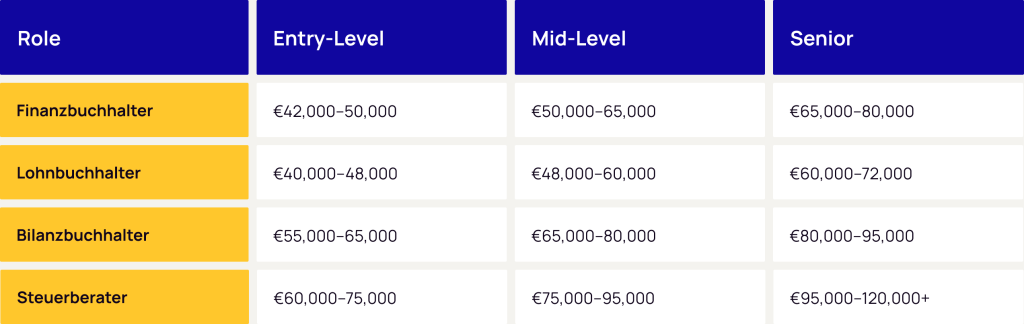
Accountant Salaries in Germany (2026)
Salaries vary depending on specialization, experience level, and location. Financial centers such as Munich, Frankfurt, and Stuttgart typically offer higher compensation.
Here is a realistic overview:
| Role | Entry-Level | Mid-Level | Senior |
| Finanzbuchhalter | €42,000–50,000 | €50,000–65,000 | €65,000–80,000 |
| Lohnbuchhalter | €40,000–48,000 | €48,000–60,000 | €60,000–72,000 |
| Bilanzbuchhalter | €55,000–65,000 | €65,000–80,000 | €80,000–95,000 |
| Steuerberater | €60,000–75,000 | €75,000–95,000 | €95,000–120,000+ |
Salaries in Baden-Württemberg are also consistently above the national average due to the region’s concentration of export-oriented industrial companies. In contrast, eastern German regions often offer slightly lower starting salaries but may provide faster entry opportunities for junior specialists.
Requirements to Work as an Accountant in Germany
Employers typically evaluate candidates based on four core criteria.
1. Accounting Knowledge
Understanding bookkeeping principles and reporting logic is essential. Familiarity with HGB is especially valuable for most positions.
2. German Language Skills
German at B2 level or higher is usually required because accountants must:
- read legal documents
- communicate with authorities
- write internal reports
- coordinate with tax advisors
English alone is rarely sufficient outside international corporations.
3. Software Skills
Employers expect experience with:
- Excel
- DATEV or Lexware
- ERP systems such as SAP (optional but beneficial)
Among these tools, DATEV is particularly important because it is the dominant accounting platform used by German tax advisors and many SMEs. Even basic practical exposure to DATEV can significantly increase interview chances for international applicants.
4. Recognized Qualification
A German Weiterbildung certificate or IHK qualification often compensates for missing local academic credentials.
This is particularly important for international applicants.
Career Entry Paths into Accounting in Germany
There are several structured routes into the profession. Choosing the right one depends on your background and goals.
| Path | Duration | Language | Entry Difficulty | Recommended For |
| Ausbildung | 2–3 years | German | Medium | Young applicants starting from scratch |
| University degree | 3–5 years | German/English | High | Academic career plans |
| Weiterbildung (IHK) | 6–12 months | German | Low–Medium | Career changers and immigrants |
For many international professionals, Weiterbildung programs provide the fastest entry into the labor market.
AZAV-Certified Weiterbildung and Career Entry
For many international professionals, the fastest and most practical path into accounting in Germany is not a full university degree, but a structured Weiterbildung program with a recognized qualification.
AZAV-certified providers are especially important for candidates planning to apply for a Bildungsgutschein, as funding is usually only available for approved programs offered by certified institutions.
DWW Akademie is one example of an AZAV-certified education provider offering accounting-focused Weiterbildung programs in areas such as Finanzbuchhaltung, Lohnbuchhaltung, and preparation for roles involving DATEV and German accounting standards. These programs are designed to help international professionals adapt their existing experience to German employer expectations and improve job-market readiness.
For many migrants and career changers, this route offers a faster and more realistic entry into accounting roles than starting from zero with a multi-year Ausbildung or university degree
Can Foreigners Work as Accountants in Germany?
Yes. Many accounting professionals in Germany have international backgrounds. However, foreign experience alone is rarely enough.
Employers usually expect adaptation to:
- German accounting standards (HGB)
- local tax structures
- German business communication
- accounting software used in Germany
Completing a local certification significantly increases employment opportunities.
Professionals from India, Pakistan, Eastern Europe, and other non-EU countries often start in junior roles before moving into specialized positions after gaining local experience.
Where Accountants Work in Germany
Accounting specialists are employed across nearly all industries.
Common employers include:
- small and medium-sized companies
- logistics and manufacturing firms
- consulting agencies
- IT companies
- international corporations
- public institutions
Because accounting is required everywhere, geographic flexibility is higher than in many other professions.
How to Find an Accounting Job in Germany
The job search process usually follows several practical steps.
Step 1: Obtain a recognized qualification
German employers value structured Weiterbildung programs and IHK certificates.
Step 2: Improve German language skills
Reaching at least B2 level dramatically increases interview chances.
Step 3: Choose a specialization
Financial accounting and payroll accounting are the most common entry points.
Step 4: Adapt your CV to German standards
Describe concrete responsibilities, software tools, and reporting frameworks.
Step 5: Apply systematically
Popular job platforms include:
- StepStone
- Indeed
- company career portals
Many candidates receive interview invitations within several months after completing qualification programs.
How Long It Takes to Start a Career
With structured preparation, entering the accounting profession in Germany is typically achievable within six to twelve months, depending on language level, qualification background, and job market conditions.
A typical timeline looks like this:
- 3–6 months: accounting training
- parallel: German language improvement
- 1–3 months: job applications and interviews
Consistency is the key success factor.
Is Accounting a Future-Proof Career in Germany?
Despite automation and digitalization, accounting remains a stable profession. Software increasingly handles repetitive tasks, but companies still rely on specialists who understand regulations, reporting logic, and compliance requirements.
As regulations become more complex and international reporting standards expand, qualified accountants continue to play a critical role in business operations.
For international professionals looking for a structured entry into the German labor market, accounting remains one of the most reliable career pathways in 2026.
Conclusion
Accounting remains one of the most stable and accessible career paths in Germany for both local and international professionals. Strong employer demand, clear career progression, and relatively fast entry routes make it especially attractive for migrants looking to build long-term professional security.
Success in this field depends less on having a perfect academic background and more on practical readiness: understanding German accounting standards, developing strong software skills, improving German language proficiency, and obtaining qualifications recognized by local employers.
For many international candidates, structured Weiterbildung programs provide the most realistic and efficient way to enter the profession. With the right preparation, accounting can become not only a reliable job, but a sustainable long-term career in the German labor market.
FAQ
Can I work as an accountant in Germany without a German degree?
Yes. A German university degree is not always required. Many employers value practical accounting knowledge, software skills, and recognized local qualifications such as Weiterbildung certificates or IHK programs more than formal academic diplomas—especially for entry and mid-level roles.
Is German language mandatory for accounting jobs?
In most cases, yes. German at B2 level or higher is usually expected because accountants work with legal documents, invoices, tax regulations, and communication with authorities. English-only roles are mostly limited to large international corporations.
Is DATEV really necessary?
DATEV is one of the most important accounting tools in Germany, especially in SMEs and tax consulting environments. Even basic practical experience with DATEV can significantly improve your chances of getting interviews.
Can foreigners get hired without German work experience?
Yes, but local adaptation is important. Employers want to see understanding of HGB, German accounting processes, and workplace communication standards. A local Weiterbildung often helps bridge this gap.
What is the easiest accounting role to start with?
Finanzbuchhalter and Lohnbuchhalter are usually the most accessible entry points for international professionals. These roles offer stable demand and clear career progression toward more senior positions such as Bilanzbuchhalter.
How long does it take to start working in accounting?
For many candidates, entering the field takes around 6–12 months depending on German level, prior experience, and qualification pathway. Structured Weiterbildung programs often accelerate this process significantly.
Can I get a Bildungsgutschein for accounting training?
Yes. Accounting programs are commonly funded through Bildungsgutschein if the provider is AZAV-certified and the training improves your employment prospects. Approval depends on your individual case and your advisor at the Agentur für Arbeit or Jobcenter.
Is accounting a safe career despite AI and automation?
Yes. While automation reduces repetitive manual tasks, employers still need specialists who understand regulations, compliance, reporting logic, and financial responsibility. AI supports accountants — it does not replace qualified professionals.




Leave a Reply