


Accounting is one of the most stable fields in Germany. Every company operating in the country is legally required to maintain proper financial records under the German Commercial Code (Handelsgesetzbuch, HGB §238). Compliance with these standards requires genuine expertise — not just bookkeeping, but a working knowledge of German tax law and reporting obligations. As a result, qualified accounting professionals remain essential across industries — from small businesses to multinational corporations.
If you are planning to start an accounting career in Germany or adapt your foreign experience to the German market, this guide explains the realistic pathways, requirements, qualifications, and career prospects.
Is accounting a regulated profession in Germany?
Unlike doctors or lawyers, accountants in Germany are not required to hold a state licence. There is no single mandatory certification to work as an in-house Buchhalter. However, employers do have clear expectations around local knowledge, language, and software.
A University degree can be helpful, but it is not always required. In practice, recognized professional training and local experience are often more important.
What accounting roles are available in Germany?
Understanding the structure of accounting roles in Germany helps set realistic expectations for entry and career growth.
Financial accountant (Buchhalter / Finanzbuchhalter)
This is the most common entry-level role, with responsibilities that typically include recording business transactions, processing invoices, managing accounts payable and receivable, and preparing basic financial reports.
Many international professionals begin their careers at this level.
Balance sheet accountant (Bilanzbuchhalter)
A Bilanzbuchhalter prepares annual financial statements and performs higher-level financial analysis. In Germany, this role usually requires several years of experience and a formal examination at the Chamber of Industry and Commerce (IHK).
Since 2020, this qualification is officially recognized as Bachelor Professional in Accounting, equivalent in level to a university bachelor’s degree within the German qualification framework.
Tax advisor (Steuerberater) and Auditor (Wirtschaftsprüfer)
These are advanced professional titles requiring additional examinations, practical experience, and strong German language proficiency. They represent the senior end of the profession, not a starting point for newcomers.
Can foreigners become accountants in Germany?
Yes. Many accounting professionals in Germany have international backgrounds, including applicants from outside the European Union such as India, Pakistan, Ukraine, and other countries with strong finance and business education systems. However, foreign experience alone is rarely enough to enter the profession without additional adaptation to German standards.
Employers typically expect candidates to have working knowledge of:
- German accounting standards (HGB)
- local tax rules and compliance procedures
- professional proficiency in written and spoken German
- accounting software commonly used in Germany (such as DATEV or SAP)
In addition, non-EU applicants may need to go through formal qualification recognition through databases such as Anabin. In some cases — for example, applicants from India — an APS certificate is also required. Visa eligibility will depend on whether you are entering through an employment or study pathway.
Three main pathways to become an accountant in Germany
There are several realistic routes depending on your background, experience level, and career goals.
1. Apprenticeship (Ausbildung)
The dual vocational training system combines classroom education with paid practical work in a company. Programs usually last 2 to 3 years.
There is no direct accountant Ausbildung program, but common entry paths include:
- Steuerfachangestellte (tax clerk)
- Industriekaufmann (industrial clerk)
- Kaufmann für Büromanagement (office management specialist)
This pathway is best suited for younger applicants or those with no prior accounting background.
2. Professional requalification (Weiterbildung)
For many international professionals, Weiterbildung is the fastest and most practical option — particularly if you already understand accounting principles but need to adapt to the German system.
These programs typically last 6 to 18 months and focus on:
- German accounting law (HGB)
- taxation basics
- financial reporting
- accounting software such as DATEV
- IHK certification preparation (optional)
Some programs can be fully funded through the German employment agency (Agentur für Arbeit) under certain residence statuses. At DWW Academy, we specialise in helping migrants build accounting careers in Germany. Book a free consultation to find out whether you’re eligible and which pathway makes sense for your background.
3. University degree in accounting or business administration
Studying accounting at a German university gives students a solid grounding in both German and international accounting standards and long-term career advantages.
Programs typically run three to four years for a bachelor’s degree and one to two years for a master’s. Students cover both German accounting standards (HGB) and international standards (IFRS).
Graduates are well positioned for senior roles in tax consulting, auditing, or financial management.
However, this path requires solid academic background and usually German language skills at C1 level.
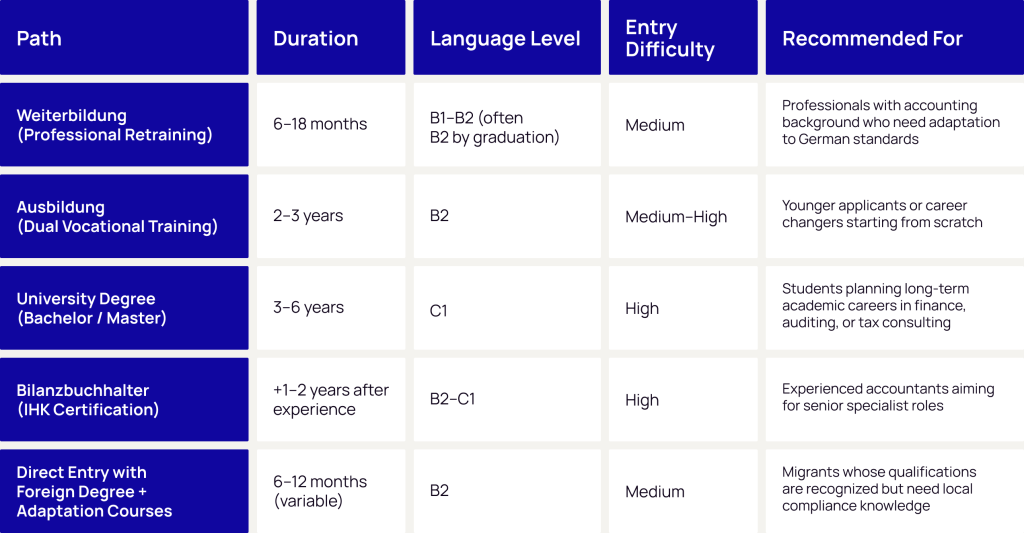
Comparison of accounting career pathways in Germany
| Path | Duration | Language Level | Entry Difficulty | Recommended For |
| Weiterbildung (Professional requalification) | 6–18 months | B1–B2 (often B2 by graduation) | Medium | Professionals with accounting background who need adaptation to German standards |
| Ausbildung (Apprenticeship) | 2–3 years | B2 | Medium–High | Younger applicants or career changers with no prior accounting background |
| University degree (Bachelor / Master) | 3–6 years | C1 | High | Students planning careers in finance, auditing, or tax consulting |
| Bilanzbuchhalter (IHK Certification) | 1–2 years (post-experience) | B2–C1 | High | Experienced accountants aiming for senior specialist roles |
| Direct Entry with Foreign Degree + Adaptation Courses | 6–12 months (variable) | B2 | Medium | Migrants with a recognised foreign degree who need to build local compliance knowledge |
Language requirements for accountants in Germany
German language proficiency is one of the most important factors for employment. Most junior roles require at least B2 German, while advanced positions typically expect C1. Even if your studies are in English, most accounting work involves communication with tax authorities (Finanzamt), auditors, and management in German.
Recognition of foreign qualifications
If you already hold an accounting degree from another country, your degree can be assessed through the official Anabin database. Recognition strengthens your application, but does not replace the need for knowledge of German accounting standards. Most employers expect candidates to complete additional training in Germany.
Starting out as an international professional
Most international professionals enter through junior specialist roles rather than general accountant positions. Starting in payroll, accounts payable, or accounts receivable allows you to build local experience before moving into broader financial accounting.
Salary expectations for accountants in Germany in 2026
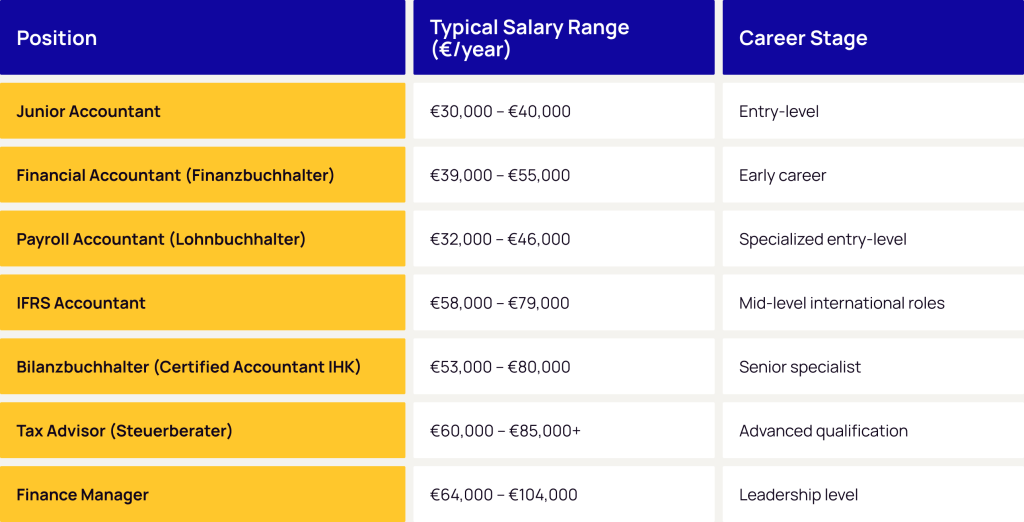
Accounting salaries in Germany depend on experience, specialization, certification level, and company size. The table below shows typical annual gross salaries.
| Position | Typical Salary Range (€/year) | Career Stage |
| Junior Accountant | €30,000 – €40,000 | Entry-level |
| Financial Accountant (Finanzbuchhalter) | €39,000 – €55,000 | Early career |
| Payroll Accountant (Lohnbuchhalter) | €32,000 – €46,000 | Entry-level specialist |
| IFRS Accountant | €58,000 – €79,000 | Mid-level |
| Bilanzbuchhalter (IHK-certified accountant) | €53,000 – €80,000 | Senior specialist |
| Tax Advisor (Steuerberater) | €60,000 – €85,000+ | Senior level |
| Finance Manager | €64,000 – €104,000 | Leadership level |
Salaries are typically higher in southern and financial regions such as Baden-Württemberg, Bavaria, and Hesse, especially in cities like Frankfurt, Munich, and Stuttgart.
Step-by-step plan to start an accounting career in Germany
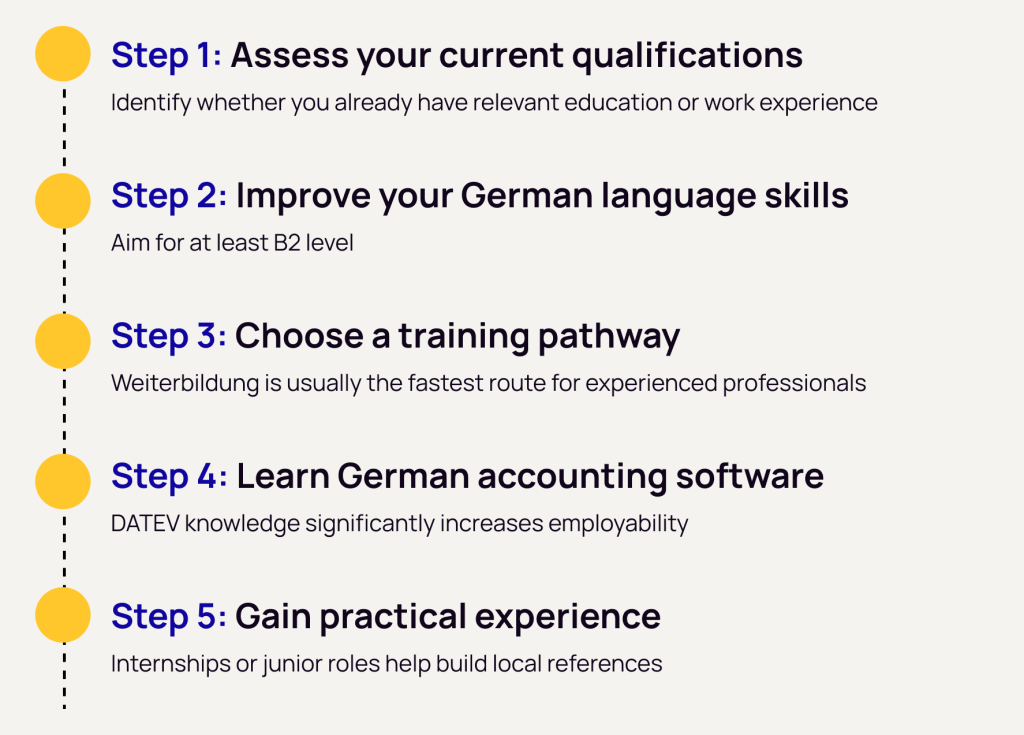
If you are planning a career in accounting in Germany, here are the steps:
Step 1: Assess your current qualifications
Identify whether you already have relevant education or work experience.
Step 2: Improve your German language skills
Aim for at least B2 level.
Step 3: Choose a training pathway
Weiterbildung is usually the fastest route for experienced professionals.
Step 4: Learn German accounting software
DATEV knowledge significantly increases employability.
Step 5: Gain practical experience
Internships or junior roles give you hands-on experience with German accounting systems.
Is accounting a good career choice in Germany?
Yes. Accounting remains one of the most reliable professional fields in Germany due to legal reporting obligations and steady demand across industries.
With the right combination of language skills, professional training, and practical experience, international specialists can successfully build long-term careers in the German accounting sector.
If you are ready to take the next step, book a free consultation with DWW Academy to find out where to start.
FAQ:
Is it possible to work as an accountant in Germany without a German degree? Yes. A foreign degree combined with recognised professional training and local work experience is often sufficient for entry-level roles. Most employers care more about your knowledge of HGB and German accounting software than where you studied.
How long does it take to become an accountant in Germany as a foreigner? It depends on your background. Professionals with prior accounting experience typically enter the job market within 6 to 18 months after completing a Weiterbildung program. Those starting from scratch through an Ausbildung or university degree should expect two to six years.
Who can get funding for a Weiterbildung program in Germany? Funding through the Agentur für Arbeit is available to people who are registered as job seekers or at risk of unemployment, hold a valid residence permit that allows employment, and meet the agency’s eligibility criteria. EU citizens and certain non-EU residents with a work permit may qualify. The best way to find out is to book an appointment at your local Agentur für Arbeit office or speak to a career advisor before enrolling.
Do I need to speak German to work as an accountant in Germany? Yes — professional German is essential. Most junior roles expect at least B2 level, and senior or client-facing positions typically require C1. Accounting work involves regular communication with tax authorities, auditors, and management, all of which is conducted in German.
Is DATEV knowledge really necessary? In Germany, yes — particularly if you want to work in small or mid-sized companies or accounting firms. DATEV is the dominant accounting software in the market. SAP is more common in larger corporations. Having at least one of these on your CV significantly improves your chances of being shortlisted.
Can I become a tax advisor (Steuerberater) in Germany as a foreigner? Yes — but it is a long path. The Steuerberater qualification requires several years of relevant work experience in Germany, passing a demanding state examination, and strong German language skills at C1 or above. It is a realistic long-term goal, not an entry point.




Leave a Reply