


Germany continues to invest heavily in workforce retraining and professional development, and one of the most powerful tools available to residents is the Bildungsgutschein — a government training voucher that can fully fund career-oriented education. In 2026, the program plays a central role in helping jobseekers, migrants, and employees adapt to changing labor-market demands, especially in fields like accounting, IT, data analytics, and digital business operations.
This guide explains what the Bildungsgutschein covers, who qualifies, how the approval process works, and what increases your chances of receiving funding.
What Is a Bildungsgutschein?
A Bildungsgutschein is an education voucher issued by the Agentur für Arbeit or Jobcenter that pays 100% of the cost of approved vocational training programs (Weiterbildung) or full career retraining (Umschulung). It is not a loan and does not require repayment after graduation.
The voucher may cover:
- tuition fees
- study materials
- certification costs
- transportation expenses
- accommodation (if required)
- childcare support in some cases
If you already receive unemployment benefits such as Arbeitslosengeld I or Bürgergeld, these payments typically continue during your training period.
The goal of the program is straightforward: improve employment prospects and reduce long-term unemployment by funding skills that employers currently need.
Who Can Apply for a Bildungsgutschein?
Contrary to common assumptions, the program is not limited to people who are already unemployed. You may qualify if you are:
- unemployed and registered with the Agentur für Arbeit
- receiving Bürgergeld through Jobcenter
- at risk of losing your job
- working but lacking formal qualifications
- planning a structured career upgrade within your profession
- a non-EU resident with a valid work permit or Blue Card
The key requirement is registration as job-seeking (arbeitssuchend) or unemployed (arbeitslos).
Importantly, you can register as job-seeking up to three months before your contract ends, which allows you to begin the application process early.
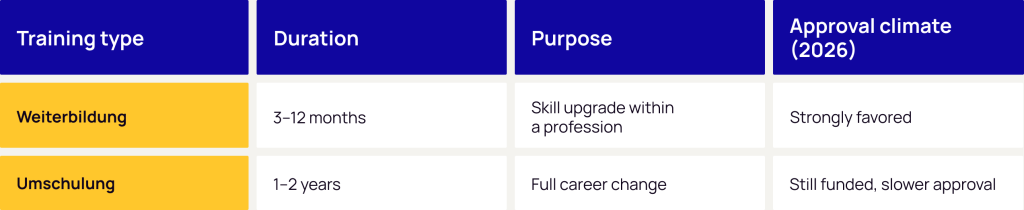
Weiterbildung vs. Umschulung: Which Training Gets Approved Faster?
The Bildungsgutschein supports two different types of education pathways:
| Training type | Duration | Purpose | Approval climate (2026) |
| Weiterbildung | 3–12 months | Skill upgrade within a profession | Strongly favored |
| Umschulung | 1–2 years | Full career change | Still funded, slower approval |
In 2026, shorter programs that lead quickly to employment receive higher priority. Advisors are more likely to approve training that helps candidates return to work within months rather than years.
For experienced professionals, upgrading existing expertise with digital or AI-related skills often leads to better approval outcomes than switching careers entirely.
Why Germany Funds Professional Training
Germany faces ongoing shortages of qualified specialists in several sectors, including:
- accounting and payroll administration
- IT and data analytics
- logistics and supply chain management
- engineering support roles
- digital marketing and automation
Because of demographic change and rapid technological transformation, the government invests in Weiterbildung programs that help workers adapt to new requirements without leaving their professions.
Training that clearly matches labor-market demand has the highest approval probability.
What a Bildungsgutschein Covers Financially
The voucher usually covers all direct training costs, but additional support may also be available depending on your situation.
Possible benefits include:
- childcare support of approximately €130 per month per child
- travel reimbursement for public transport
- accommodation subsidies when commuting is not possible
- continuation of unemployment benefits
- monthly Weiterbildung bonuses in some certified programs
- exam completion bonuses in qualification-based training tracks
These additional payments help ensure that participants can complete training without financial pressure. Funding rules are defined under the German Social Code (SGB III)
Step-by-Step Application Process
Applying for a Bildungsgutschein involves several structured steps. Preparing early significantly improves approval chances.
Step 1: Choose an AZAV-Certified Course
Only programs approved under AZAV certification standards qualify for funding. This ensures the course meets labor-market relevance criteria.
Funding typically requires both an AZAV-certified provider and an eligible training program, so it is important to check both before applying.
DWW Akademie is one example of an AZAV-certified education provider offering career-oriented Weiterbildung programs in areas such as accounting, payroll, digital professions, and business administration. Their programs are designed to align with labor-market demand and can qualify for Bildungsgutschein funding depending on the applicant’s individual case and advisor approval.
Typical funded programs include:
- financial accounting
- payroll accounting
- data analytics
- AI-assisted business workflows
- software development
- SAP training
- project management
After applying to a training provider, request an information package containing course duration, structure, and certification details.
Step 2: Register as Job-Seeking
Register online through the Agentur für Arbeit portal or visit your local office. This step officially activates your eligibility pathway.
Early registration signals motivation and planning — both important factors during evaluation.
Step 3: Schedule a Consultation Appointment
Request a Beratungstermin with your advisor. During this meeting, you present your training request and explain your career goals.
Approval rarely happens immediately. Multiple consultations are common and should be expected.
Step 4: Prepare Supporting Documents
Bring the following documents to your meeting:
- passport or residence permit
- registration certificate (Anmeldung)
- CV (preferably in German)
- diplomas or certificates
- course information package
- 2–3 job advertisements matching the skills taught in the course
Printed job postings are especially powerful evidence because they demonstrate real employer demand.
Step 5: Receive and Activate the Voucher
If approved, you receive a written Bildungsgutschein specifying:
- training objective
- course duration
- provider category
- geographic validity
- expiration date
Most vouchers remain valid for three months, so you must begin training within this timeframe.
What Advisors Evaluate Before Approval
There is no automatic right to receive a Bildungsgutschein. The decision is discretionary and based on employability impact.
Advisors typically assess:
- whether training improves job prospects
- whether the profession is in demand locally
- whether the course matches your background
- whether employment without training is realistic
- whether the program duration is appropriate
A strong application clearly connects your previous experience with future career goals.
Common Reasons Applications Are Rejected
Many applicants are denied funding because their request lacks a clear employment strategy.
Typical rejection reasons include:
- choosing a course unrelated to prior experience
- selecting a non-certified provider
- missing documentation
- unclear motivation
- weak labor-market evidence
- unrealistic career expectations
Preparing job-market research in advance significantly reduces these risks.
How to Increase Your Approval Chances
Successful applicants usually demonstrate three things:
1. Labor-market relevance
Show that employers are actively hiring for the skills you plan to learn.
2. Career continuity
Explain how the training builds on your previous professional background.
3. Fast employability
Programs lasting 3–6 months are often easier to justify than multi-year retraining.
In 2026, advisors increasingly support applicants who upgrade their existing expertise instead of starting from zero in a completely new profession.
Can Non-EU Residents Receive a Bildungsgutschein?
Yes. Many international professionals qualify if they:
- legally reside in Germany
- hold a valid residence permit or Blue Card
- register as job-seeking
- demonstrate realistic employment prospects after training
Migrants with prior professional experience often benefit especially from Weiterbildung programs that adapt their skills to German standards.
Conclusion
The Bildungsgutschein remains one of the most valuable career-development tools available in Germany in 2026. It allows residents to gain job-relevant qualifications without financial risk while maintaining access to social support during training.
Approval depends less on formal eligibility and more on preparation. Applicants who choose AZAV-certified programs aligned with labor-market demand — and who clearly explain how training leads to employment — have the strongest chances of success.
With the right strategy, the Bildungsgutschein can become a decisive step toward stable employment and long-term career growth in Germany.
FAQ
Is the Bildungsgutschein only for unemployed people?
No. While unemployed individuals and people receiving Bürgergeld are the most common applicants, employed professionals may also qualify — especially if they are at risk of losing their job, need formal qualifications, or require additional training to remain employable. Approval always depends on individual circumstances and the advisor’s assessment.
Can I get a Bildungsgutschein if I already have a job?
Yes, in some cases. If your current position is unstable, your qualifications are outdated, or additional training is necessary for long-term employment, your advisor may approve funding. Shorter Weiterbildung programs are often easier to justify than full retraining.
Do I need German citizenship to apply?
No. German citizenship is not required. Non-EU residents may qualify if they legally live in Germany, hold a valid residence permit, and can demonstrate realistic employment prospects after training.
Does the Bildungsgutschein cover 100% of course costs?
Usually yes. The voucher can cover tuition fees, study materials, exam fees, transport costs, and in some cases accommodation or childcare support. If you already receive unemployment benefits, these payments often continue during training.
How long does approval take?
There is no fixed timeline. Some applicants receive approval after one consultation, while others need several appointments and additional documentation. The process often takes several weeks depending on your local Agentur für Arbeit or Jobcenter.
Can I choose any course I want?
No. The course must usually be relevant to your employment prospects and offered by an AZAV-certified provider. Advisors are more likely to approve programs that match labor-market demand and improve your chances of finding work quickly.
What happens if my application is rejected?
A rejection does not always mean the end of the process. In many cases, applicants can improve their documentation, provide stronger labor-market evidence, or choose a more suitable training program and reapply after another consultation.
Is Weiterbildung easier to get approved than Umschulung?
In many cases, yes. Shorter Weiterbildung programs are often approved faster because they help candidates return to work sooner. Full Umschulung programs can still be funded, but they usually require stronger justification and longer review.




Leave a Reply