


Salary figures in Germany are almost always quoted gross, before tax and social insurance. The most recent official data describes 2025: the Statistisches Bundesamt (Destatis) puts the median full-time gross annual salary at €54,066 including special payments, while the Bundesagentur für Arbeit reports a median of €4,217 gross per month. The arithmetic average sits far higher, at €64,441 per year, because top earnings pull it upwards. Average, median and private salary reports measure different things and cannot be swapped for one another.
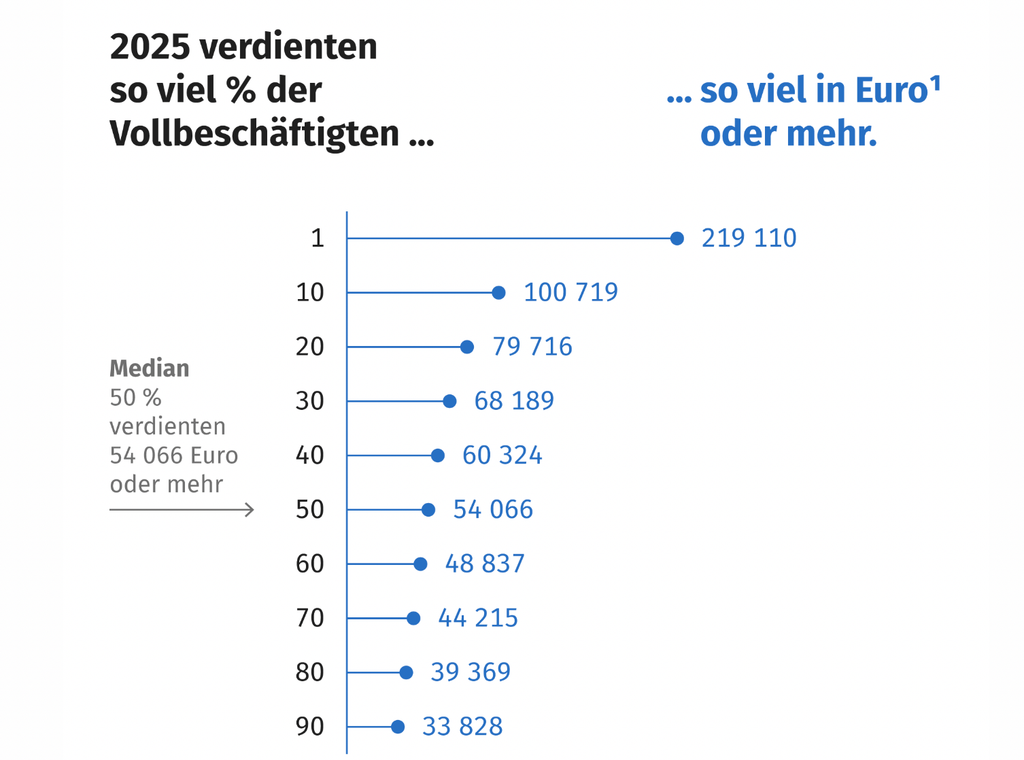
Source: Statistisches Bundesamt (Destatis), press release 113/2026
What is the average salary in Germany in 2026?
No complete official figure for 2026 exists yet. German earnings statistics report on a full calendar year, so the newest official datasets available in 2026 describe 2025. They are the base for salary planning this year, not a forecast of it.
Destatis reports an average gross annual salary of €64,441 for full-time employees in 2025, up from €62,235 the year before. Measured by month, full-time employees earned €4,784 gross on average in April 2025, excluding special payments. The Bundesagentur für Arbeit, which draws on employers’ social insurance returns, reports a median of €4,217 gross per month as of 31 December 2025.
Quarterly data shows the direction of travel. Nominal wages in the first quarter of 2026 were 4.1% above the same quarter a year earlier, while consumer prices rose 2.2%. Real wages were therefore 1.8% higher.
Average vs median salary: why one number is not enough
Two words do most of the damage in salary conversations. “Average” usually means the arithmetic mean: the total divided by the number of people. “Median” is the middle value, where half of employees earn more and half earn less.
The gap between them is wide. In 2025 the mean full-time gross annual salary was €64,441 and the median was €54,066, a difference of more than €10,000. High earnings lift the mean without changing what a typical employee takes home. Destatis reports that the top 10% of full-time employees earned €100,719 or more in 2025, the bottom 10% earned €33,828 or less, and the top 1% reached €219,110 or more.
For judging a job offer, the median salary Germany reports is the more useful anchor. Around 70% of full-time employees earned €44,215 or more in 2025.
Which salary number should you use?
Different institutions publish different figures, and each answers a different question. Reading the label matters more than reading the number.
| Source | What it measures | Latest figure | Best used for |
| Destatis, monthly earnings | Average gross monthly pay, full-time, excluding special payments | €4,784 (April 2025) | General orientation |
| Destatis, annual earnings | Gross annual pay, full-time, including special payments | Median €54,066, mean €64,441 (2025) | Comparing annual packages |
| Bundesagentur für Arbeit, Entgeltatlas | Median gross monthly pay, full-time, by profession and region | €4,217 (31 December 2025) | Checking a specific job title |
| Statutory Mindestlohn | Legal minimum gross hourly rate | €13.90 per hour (from 1 January 2026) | The legal floor |
| Stepstone Gehaltsreport | Median gross annual pay from self-reported data | €53,900 (2026 edition) | A private market benchmark |
One caution on the Destatis annual figures: they cover full-time employees with seven or more months of employment, with part-year earnings scaled up to twelve.
Gross vs net salary in Germany
German employment contracts, job advertisements and statistics quote Brutto, the gross salary. Netto is what reaches your account, and the difference is substantial.
Two things come off the gross salary. First, income tax (Lohnsteuer), plus church tax if you are a registered member of a church. Second, social insurance. The 2026 rates are 18.6% for pension insurance, 14.6% for health insurance plus an average supplementary contribution of 2.9%, 3.6% for long-term care insurance and 2.6% for unemployment insurance. Employer and employee each carry roughly half, so the employee’s share comes to about a fifth of gross pay before any income tax. Employees over 23 without children pay a higher long-term care rate.
Income tax starts above the Grundfreibetrag, the basic tax-free allowance, which is €12,348 for a single person in 2026 and €24,696 for jointly assessed couples. Your Steuerklasse, or tax class, then determines how much is withheld each month.
The Bundesfinanzministerium runs an official Lohn- und Einkommensteuerrechner. Note what it does and does not do: it calculates income tax, and the ministry states plainly that it is not a gross-to-net calculator, because social contributions fall outside its scope. For a net salary Germany estimate, use a Brutto-Netto-Rechner and read the result as an estimate rather than a payslip. Individual tax questions belong with a Steuerberater or your Finanzamt.
Germany minimum wage in 2026
The statutory minimum wage, the gesetzlicher Mindestlohn, rose to €13.90 gross per hour on 1 January 2026, up from €12.82. A further step to €14.60 follows on 1 January 2027.
The rate is hourly and gross, so monthly income depends on contracted hours. Destatis calculates that at full-time hours the 2026 rate works out at roughly €2,343 gross per month, about 60% of the gross median for full-time employees. The Minijob threshold moved with it, to €603 per month.
Salary by profession and industry in Germany
Profession, industry and formal qualification move salaries more than any other factor.
The Bundesagentur für Arbeit reports 2025 median monthly gross pay by qualification level: €3,133 without a vocational qualification, €4,069 with a recognised one and €6,146 for graduates. These are group medians across the whole workforce. They describe how the labour market is structured, not an outcome anyone can promise an individual.
Industry adds a second layer. Destatis puts the 2025 median annual gross salary at €77,522 in energy supply and €76,594 in financial and insurance services, against €35,545 in hospitality and €35,689 in agriculture and forestry.
For a specific job title, the Entgeltatlas run by the Bundesagentur für Arbeit is the official reference, with medians by profession and region. The Stepstone Gehaltsreport offers a private benchmark built from self-reported data.
Regional salary differences in Germany
Where you work changes the number on the contract. In 2025 the highest median monthly gross salaries were in Hamburg at €4,768, Baden-Württemberg at €4,546 and Hessen at €4,530. The lowest were in Mecklenburg-Vorpommern at €3,497, Thüringen at €3,508 and Sachsen-Anhalt at €3,563.
The east–west gap shows up in the annual data too. Destatis reports a median of €46,013 in the eastern federal states excluding Berlin, against €55,435 in the west, a difference of €9,422.
Gross pay is only half the picture. Rent and living costs run highest where pay is highest, so a larger gross salary in Hamburg or Munich does not automatically leave more at the end of the month.
Source: Bundesagentur für Arbeit, press release 27/2026
Conclusion
A salary figure means little on its own. It becomes readable once you know six things: which measure it is, who published it, whether it is gross or net, which profession it covers, which region it describes, and how it fits your own hours, tax class and household. Check any offer against the Entgeltatlas median for your profession and region, not the national average, then convert the gross figure to net.
FAQ
What is the average salary in Germany in 2026? No official 2026 figure has been published yet. The most recent official data covers 2025: an average full-time gross annual salary of €64,441 and a median of €54,066, both including special payments such as holiday and Christmas pay.
What is the median salary in Germany? The Bundesagentur für Arbeit reports a median of €4,217 gross per month for full-time employees subject to social insurance, as of 31 December 2025. Destatis reports an annual median of €54,066 for 2025. The two figures differ because they cover different populations and treat special payments differently.
Is salary in Germany shown gross or net? Gross. Job advertisements, employment contracts and official statistics all quote Brutto. Your Netto depends on your tax class, church membership, health insurance fund and number of children.
What is the minimum wage in Germany in 2026? The statutory minimum wage has been €13.90 gross per hour since 1 January 2026, and it rises to €14.60 on 1 January 2027. Because the rate is hourly, monthly income depends on contracted hours.
How much salary is good in Germany? No single threshold applies. A gross salary above the median for your profession and region is a reasonable benchmark. Around 70% of full-time employees earned €44,215 or more in 2025, and €80,000 placed someone in the top 20%.
Which professions pay the most in Germany? By industry, Destatis puts energy supply at €77,522 and financial and insurance services at €76,594 in median annual gross pay for 2025. For an individual job title, the Entgeltatlas gives medians by profession and region.
How can I check if my salary offer is fair? Look up your profession and region in the Entgeltatlas and compare the offer against that median, not the national average. Then convert the gross figure to net with a Brutto-Netto-Rechner. Check the contracted hours too, since an hourly comparison can read differently from a monthly one.



Leave a Reply